
The short answer
Colour carries 0.016 bits per cord about a cord’s number, in both major collections. That is below the 0.02 threshold we set for a colour legend, so we withdrew the legend claim.
How a khipu holds numbers
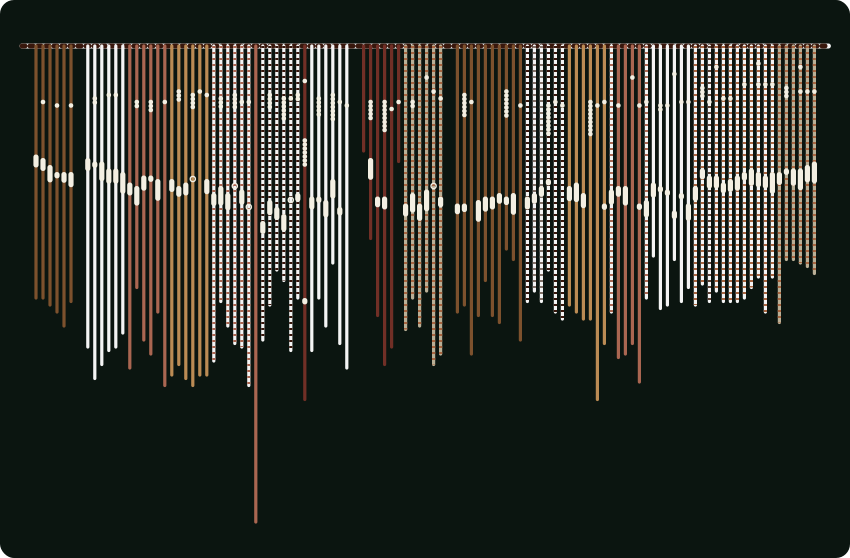
Khipus (also spelled quipus) are the knotted cords the Inka state used for its records. Since Leland Locke’s work in 1912 we can read most of their numbers. The position of a knot along the cord gives its decimal place, and the type of knot gives the digit. The drawing above shows it: a row of dots for the tens, a row of bars for the units.
What nobody can read is the rest. Every cord also has a colour, a twist and a side it hangs from. Spanish chroniclers wrote that specialists read histories and laws from these devices. No khipu with a reliable translation has survived.
What we tested
We started with one question: if you know a cord’s colour, can you guess its number better?
Each test was written down before we looked at the outcome, with the measure that would decide it and what would count as failure. That is a preregistration. Most of them compared the real colours against the same cords with their colours shuffled at random. We measured the difference in bits per cord.
Four controls, one estimate
Each control removed something that can imitate a colour code. The estimate went from 0.085 to 0.016 bits per cord.
The last drop came from position. Cords in the same place of a repeating pattern tend to share both a colour and a size of number, so part of the “colour” signal was really layout. An independent review by Fable, an AI model run separately with read-only access to our code and data, identified the confound, and the final test controls for it.
The final test accounted for position and ran separately on the two large collections, the khipus described by the Ascher and Urton projects. To pass, colour had to beat 200 shuffles, gain at least 0.02 bits per cord, and help in more than half of the khipus.
Both collections beat every shuffle, and colour helps in 75% of the Ascher khipus and 58% of the Urton khipus. The gain is 0.016 bits per cord in both, below 0.02, so the claim is withdrawn.
Deviations from protocol
Six departures, each recorded in the repository.
- We set the 0.02 minimum after seeing earlier results of 0.054 and 0.036. It was not a blind threshold.
- Our preregistrations were committed only on a local computer until we published. Their timestamps cannot be checked by anyone else before that day.
- In one test we changed how a prior was built after locking it, and a timing check showed us one partial result before the full run.
- A test on whether totals get their own colour first survived, then died once the null kept colour bands intact. It also had a parsing bug, and we saw its buggy verdict before fixing it.
- Our first check for differences between recorders used the person who typed the data, not the person who recorded the khipu.
- We treated the Khipu Field Guide as an independent check on the database. Both come from the same Harvard records.
The full list, with every test and each change, is in the repository.
Rechecking the Santa Valley match
Six khipus from the Santa Valley were matched to a 1670 census of San Pedro de Corongo, a town of 132 tributaries in six pachacas who owed 367 pesos. Urton titled his chapter on them with the question of whether they are a “Rosetta khipu”.
- The way the first cords are tied matches the published counts within one cord. Cords hang from the front or the back of the main cord, and the papers read that as which half of the town a person belonged to.
- Reading the cords ourselves, the first cord of each group of six adds up to 398. Most of the gap comes from how we split one khipu into groups of six, and the rest from two cords transcribed differently.
- Urton’s own table reads 359. He reaches 367 and a fraction by giving values to two broken cords. Twelve other first cords are zero and stay zero.
- A later paper cites totals of 381 or 382 and 86 for the two halves. Those do not add up to 367. If one half is 86, the other must be 281 or 282, so 381 may be a misprint. We used the Spanish edition of Urton’s book and have not checked the English one.
The public database and the Khipu Field Guide disagree on KH0326, the khipu in the drawing. The database gives its single knots the value 100 and the Field Guide gives them 10, so a cord read as 15 in one is 105 in the other. With the Field Guide reading, 105 of its 108 hanging cords match, and Urton’s table shows the same tens-scale values. A second khipu, KH0472, shows the same disagreement. Both sources share a lineage, so we have put the question to the maintainers rather than calling it an error.
The tool: khipu-null
We packaged the nulls from these tests as khipu-null, an open-source command-line tool. You describe a pattern (group sizes, which cords hold totals, colour repeats, attachment) and it ranks every khipu in a corpus against it. Each score is compared with versions of the same khipu where only the field that feature reads is permuted, so the layout never moves. With a pattern written from the Santa Valley khipus, five of the six rank in the top 6 of 328, and the top-6 mean is 0.994 against a null range of 0.954 to 0.986 (p = 0.001). That is a sanity check, since the pattern comes from those khipus, and no single khipu reaches q ≤ 0.05.
uvx khipu-null rank okr.csv santa-valley.yaml -o out --top 6Three questions khipu-null answers
Most work that compares khipus (quipus) with a model comes down to three questions. khipu-null was built to answer them with the same nulls used above.
| Question | What khipu-null gives you |
|---|---|
| Which khipus match a model? | A score per khipu for the features you write in a YAML pattern |
| Which five khipus best represent it? | --top 5 and a test of whether that top five beats five picked from null versions of every khipu |
| Is the match a regularity or a coincidence? | A permutation p and a Benjamini-Hochberg q per khipu, with nulls that keep groups, positions and levels fixed |
It reads any CSV with one row per cord, including exports of the Open Khipu Repository 2.1.0 with Spanish column names (codigo_kh, posicion, color, valor). The column mapping is in the khipu-null README. To try it end to end, open the quipu analysis notebook (Colab), in Spanish, which runs in under a minute.
What stands and what is next
Colour carries a small, consistent amount of information about the size of a cord’s number inside a khipu, beyond position. It is not a quirk of one research team, and it is too small to call a code.
The limit is data, not modelling. The spacing between cords is almost never recorded, in 0.008% of hanging cords in the database. Questions about how cords are grouped need it, and it has to come from photographs. It is the next instrument we plan to build.
Data and artifacts
- The Open Khipu Repository v2.1.0: 619 khipus, 54,403 cords and 110,677 knots.
- The Khipu Field Guide workbooks for 611 of them.
- Medrano and Urton (2018), FitzPatrick (2024), and Urton (2017), chapter 12 and its appendix with all 133 groups of six cords.
The tool is github.com/crafter-research/khipu-null. Preregistrations, scripts, results and both reviews are in github.com/crafter-research/khipu. The data downloads from its public sources, so you can rerun every number. If you use or mention this work, please credit “Crafter Research (2026), Khipu colours and numbers”.